
Deed Types in Delta County Records
The Register of Deeds files every instrument that transfers land. It also files instruments that attach a right to it. Deeds, mortgages, liens, and releases each carry different legal weight. The type printed on the index line matters less than the substance inside. Always read the full document. That means the parties, the execution details, the legal description, and any prior recording references.
| Deed type | What it does | Common use |
|---|---|---|
| Warranty or covenant deed | Transfers ownership with stated covenants | Ordinary sale; tax certificate required before recording |
| Quitclaim deed | Transfers whatever interest the grantor holds without a warranty | Family, estate, or corrective transfer |
| Land contract or assignment | Creates or transfers a contract interest | Seller financing and later assignment |
| Personal representative deed | Transfers estate realty through its representative | Probate disposition |
| Plat or condominium plan | Creates lots, common areas, and rights-of-way | Subdivision or condominium creation |
Not everything recorded beside a deed transfers ownership. Mortgages, assignments, releases, liens, lis pendens, and easements all appear in the same deed records, and each can bind a parcel without moving fee title. A proper release should name the exact mortgage or lien it discharges.
Open Delta County Internet Land Records
Delta County posts its Internet Land Records portal as its own application. It appears under the label "Land Records" on the county site. The search form does not render as text. So the county publishes no visible details on fields, result limits, account rules, image pricing, or the earliest year online. Draw no conclusions from the site's age.
Start with a name. Take it from a current assessment card or a deed you already hold. Try it as grantor first, then as grantee. Match what comes back against the legal description. Then check the recording date, the document number, or the book and page. If a needed field is missing from the live form, call the Register of Deeds. Do not read a blank result as proof that no deed exists.
Remember that a name search is only one path through the index. Trusts, estates, initials, punctuation, and company names appear differently from document to document. Save every variant that checks out with your parcel notes for future deed records searches.
Trace Delta County Grantors and Grantees
Every deed links two parties. The grantor gives up an interest; the grantee takes it. Chain of title is the ordered sequence of recorded transfers for one piece of land. To trace it in Delta County deed records, begin at a verified recent deed. Then step backward one link at a time.
- Find the current acquisition deed by searching the roll owner as grantee.
- Read the grantor, legal description, recording reference, and any prior-instrument citation.
- Search that grantor as an earlier grantee, then match the same land description.
- Repeat until the online index stops or a book reference requires counter work.
- Search each owner forward as grantor after acquisition to catch a later deed or correction.
- Grantor
- The party transferring an interest.
- Grantee
- The party receiving an interest.
- Chain of title
- The linked sequence of transfers for the same land.
- Book and page
- A volume-and-page citation used for an older recording.
- Instrument number
- A unique filing reference assigned to a recorded document.
Matching names alone cannot prove two entries involve the same Delta County parcel. The legal description controls. A parcel number is a handy cross-reference for current property records, though it can change when land is split or combined.
Delta County Deeds and Encumbrances
A full deed-record search reaches past the deed that conveyed the property. Mortgages secure debt. Assignments shift the mortgage holder, and discharges or satisfactions record the release. An easement grants someone a use across the land. Lis pendens warns of pending litigation affecting real estate. A recorded lien asserts a claim that may need a later release or court action to clear.
| Mortgage trail | Mortgage, assignment, modification, and discharge tied by instrument reference |
|---|---|
| Litigation trail | Lis pendens in deed records plus the related 47th Circuit Court case |
| Access trail | Easement text, legal description, plat, and any amendment or termination |
| Estate trail | Probate order or authority plus a personal representative deed |
An index abstract rarely settles priority or full terms. Pull the image itself, along with every instrument it references. A line labeled "release" only counts once you verify the lien number it discharges.
Legal Descriptions Anchor Delta County Deeds
Land in Delta County gets described several ways. A deed may cite a city lot and block. It may cite a named subdivision, section-township-range calls, quarter sections, or metes and bounds. A street address helps, but it is not the title description. Rural and historic parcels can carry the same survey identity across generations. The street label keeps changing, though.
A recorded plat fixes lot numbering, rights-of-way, common areas, and other mapped detail. The county fee page treats subdivision plats as recorded instruments in their own right. It treats condominium plats the same way. A GIS map can orient your property search. Yet the plat and the deed govern the documentary trail. When a boundary line on the ground is disputed, that is work for a licensed surveyor.
Short descriptions happen. When the latest deed leans on a prior instrument, pull that earlier deed records entry too. If land was divided or combined, keep both the old and new descriptions in hand. Follow the land itself, not just the current parcel number.
Note: One Delta County property may carry a current APN, an older book-and-page deed, and a separate recorded plat reference at the same time.
Delta County Recording Fees
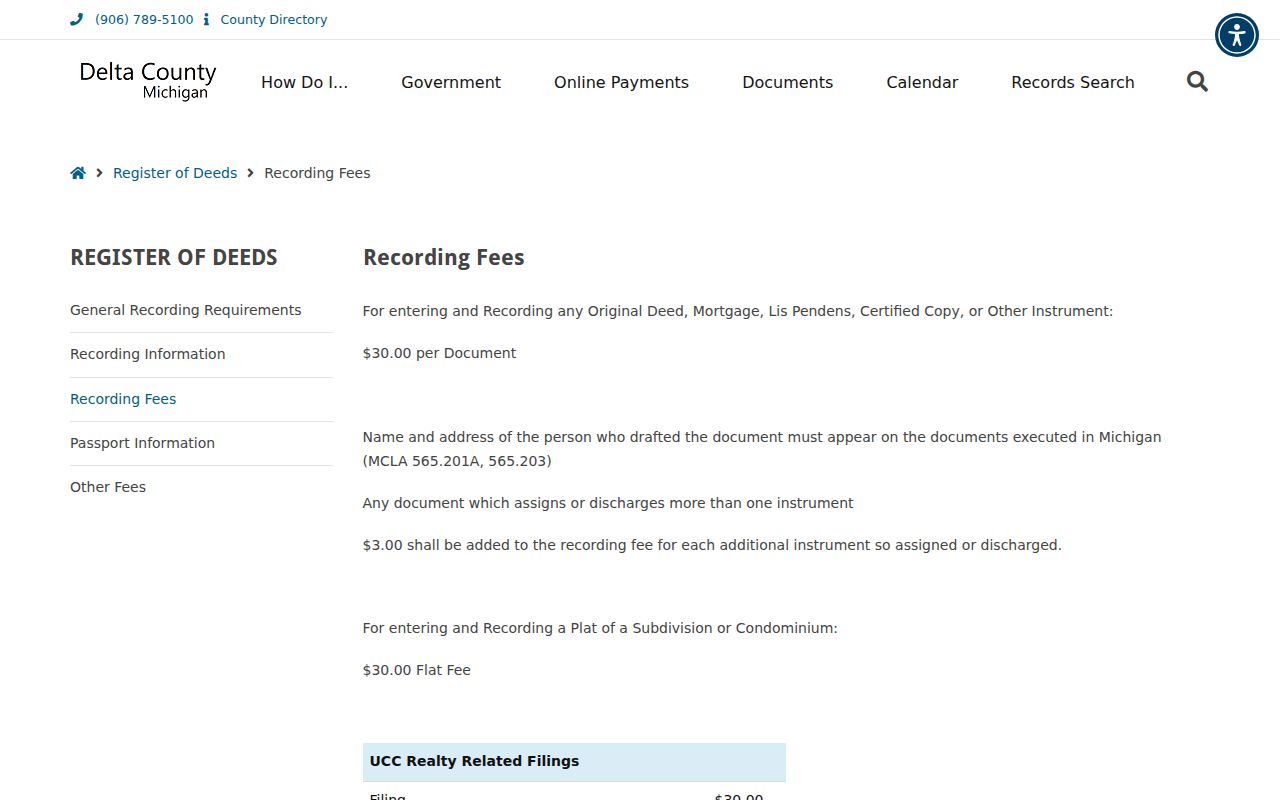
Delta County's official recording-fee schedule sets $30 for an original deed, mortgage, lis pendens, certified copy, or other instrument. A subdivision or condominium plat costs $30 to record. A UCC realty filing costs the same. A non-standard form runs $7. Each extra instrument assigned or discharged within one document adds $3.
Transfer taxes sit on top. The county share is $0.55 per $500 or fraction of value. The state takes $3.75 per $500 or fraction. That applies once transferred real-estate value reaches $100. Exemptions apply. Those tax figures can hint at a sale price. They still cannot replace the consideration stated in the deed itself.
These figures cover recording only. They are not the price of an online image or a plain copy. Ask the Register of Deeds for current search, image, copy, and certification costs. The $30 certified-copy line on the recording schedule should not be read as a per-page web fee. Do not treat it as a per-page web fee for property records.
Tax Certificates for Delta County Deeds
Michigan builds a tax-history step into certain deed recordings. Under MCL 211.135, a County Treasurer tax certificate is required for a warranty deed, land contract, assignment of land contract, personal representative deed, covenant deed, or deed carrying a warranty covenant. The certificate confirms the required tax review. It does not settle ownership. Nor will it erase liens or turn an instrument into a title opinion. The county's recording-information page lists the charge for the certificate: $5 for up to five descriptions and $0.20 for each extra description. The fee follows the filing, not the title. Michigan-drafted documents carry one more requirement. They must show the drafter's name and address under the state recording provisions the county cites. Recording staff can explain submission rules, but they cannot draft an instrument or resolve a private title dispute.
Older Delta County Deed Routes
How far back the online portal reaches is not stated in accessible county sources. Once the digital index runs dry, the Register of Deeds is the stop. The office sits at 310 Ludington Street in Escanaba. It is reachable at (906) 789-5100. The office opens at 8:00 a.m. and closes at 4:00 p.m. Staff can point you to pre-digital grantor and grantee indexes, deed books, microfilm, plats, and copy services. They can also confirm what mail requests cost and whether that route works at all.
Older land research has other aids. The Library of Michigan Delta guide lists a 1913 atlas. It also names a 1943 plat book and a 1962 plat book with an owner index. A plat can tie an old place name or owner to a legal description. It is a finding aid, though, not a substitute for the recorded deed itself.
Probate records sometimes fill the gap. The Archives of Michigan guide shows probate index coverage from 1882 through 1975. It also shows case files from 1887 through 1969. An estate transfer still needs its recorded personal representative deed or later conveyance to hold up. And since no courthouse disaster appears in the record, a missing deed cannot fairly be blamed on a fire. A flood gets the same doubt.
Get a Delta County Deed Copy
Start in the portal. Note the parties, date, type, document number or book and page, and the legal description. If an image appears, check that it is complete. For a plain or certified copy, give the Register of Deeds the exact recording reference. Ask about online, counter, and mail options. Confirm the current charge too. The office terminal is the fallback when web coverage or images fall short. A focused request beats asking staff to research everything under a common name. FOIA can reach administrative material outside the recorded index. It does not replace the court rules for a lawsuit or require an office to build a title report.
The county's recording-fee page shows the current filing table used when instruments are submitted.
Recorded is not guaranteed. Delta County deed records show filed instruments, but they are not a title opinion and may not reveal unrecorded rights.
Verify Delta County Fraud Alerts
Delta County offers no official property-fraud alert signup. A third-party county directory marks the service unavailable for Delta. That listing is not final proof. Call the Register of Deeds and ask whether monitored-name notices exist now.
Even an alert has limits. It would warn of a new filing under a watched name rather than block recording or insure title. Owners should review the actual instrument. Report suspected forgery through official channels, and get legal advice when title is at risk.
Scams imitate tax and deed offices. They may demand bank details by phone or message. Use the number from the county's own page, never one supplied by an unsolicited contact.