
Trace Delta County Previous Owners Across Record Eras
The best backward trail starts with the newest recorded conveyance on the Delta County Internet Land Records portal. Online coverage reaches back only so far. The official material publishes no stated cutoff, so treat home searching as partial. Ask the Register of Deeds for the earliest indexed year. Older reverse indexes and deed books sit elsewhere. Several dated collections beyond deeds can bridge or test the chain.
| Source | Years It Covers | Where Held | What It Shows |
|---|---|---|---|
| Register of Deeds index and books | Online start not published | County office and land-records portal | Grantor, grantee, instrument and legal description |
| Assessment rolls | 1881-1900 | Archives of Michigan | Taxed owner or interest tied to land in a given year |
| Standard atlas | 1913 | Library of Michigan | Township, city, patron and parcel context |
| Plat book with owner index | 1962 | Library of Michigan | Historic owner-to-parcel cross-reference |
| Probate index and files | Index 1882-1975; files 1887-1969 | Archives of Michigan | Estate leads when land passed through a decedent |
Keep the deed chain as your spine. A tax roll or atlas is only support. Each can point to another instrument, yet no single source proves a named person held title.
Build a Delta County Deed-Chain Timeline
A backward timeline keeps names, dates, and instruments from blurring. Begin with the newest deed. Copy the exact names rather than fixing spellings. Then log the transfer date, deed family, and book/page or instrument reference, using the legal description to confirm the land never changes.
| Transfer date | Grantor to grantee | Instrument | Stable reference |
|---|---|---|---|
| Newest recorded date | Seller to present grantee | Warranty, quitclaim, or other deed | Instrument or book/page |
| Earlier recorded date | Prior owner to later seller | Deed or estate conveyance | Instrument plus legal description |
| Older book era | Indexed parties | Bound deed volume | Book/page and recorded plat |
The table is a worksheet, not evidence. Save an image or certified copy of each instrument when the chain backs a purchase, estate, or boundary decision.
Use the Delta County Register of Deeds in Every Available Channel
The portal is only one channel. When a search stalls, contact the Register of Deeds at 310 Ludington Street in Escanaba, call (906) 789-5100, or visit during published hours of 8:00 a.m. to 4:00 p.m. Ask before you travel. Confirm which index fields the office supports, such as grantor, grantee, date, document number, book/page, parcel number, or legal description. Not every field is searchable online. The Delta County Internet Land Records portal is the county's online grantor-grantee starting point:
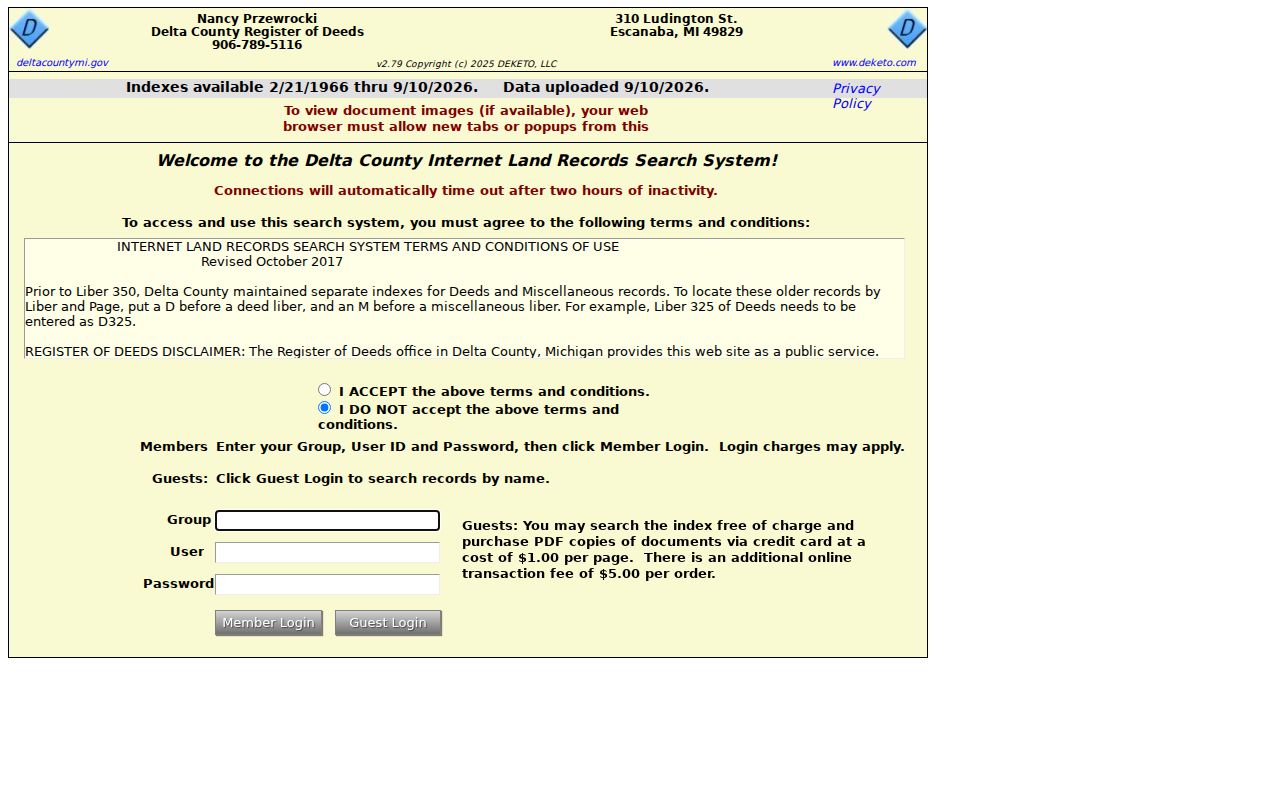
The landing screen confirms the online route. It publishes no first searchable year or complete field list. A counter request should be specific. Include the exact party spelling, a date range, the parcel number, and the full legal description. Ask about pre-online reverse indexes too. Staff may identify the next older book for you.
The recording fee schedule lists a $30 instrument recording fee. That fee is not a copy price. Confirm copy and certification costs before ordering anything.
Note: A blank web result does not prove an older transfer never occurred, since online coverage has no stated start year.
Delta County Instrument Types Can Change the Owner Trail
A warranty or covenant deed shows a transfer with stated covenants. Quitclaims are different. A quitclaim moves whatever interest the grantor held and often appears in family, corrective, or estate work, while a personal representative deed signals an estate transfer. Land contracts and assignments can shift interests too.
Mortgages, releases, easements, liens, and lis pendens belong in a separate log, since they can affect the property without changing fee ownership. Transfer-tax amounts can hint at a sale. They never replace stated consideration or a market-value analysis.
- Grantor
- The party conveying an interest.
- Grantee
- The party receiving the interest.
- Reverse index
- An index used to search one party role, often useful while stepping backward.
- Chain of title
- The ordered sequence of conveyances for the same land.
- Quitclaim and warranty
- Different forms of conveyance; neither label alone resolves every title question.
Reconstruct Delta County Former Owners Backward
Read each deed as a pointer backward. The parcel result gives a starting name. The recorder index then supplies the recorded transfer trail you follow deed by deed, anchored by the legal description.
- Find the newest deed in which the current named owner appears as grantee.
- Copy the grantor's name, recording date, legal description, and prior deed reference.
- Search that grantor as an earlier grantee, then confirm the same land description.
- Repeat until the online index ends, then continue with reverse indexes and deed books at the office.
- Legal description
- The lot, block, subdivision or metes-and-bounds identity that survives address changes.
- Book/page
- A durable reference to a recorded volume and page.
Follow Estate Transfers in Delta County Probate Sources
A clean sequence can break when an owner died. Heirs may convey separate interests, or a personal representative may sell the real estate. Search the deed index for a personal representative deed, quitclaims from heirs, and later corrective instruments. Then chase the probate name.
The Archives of Michigan Delta guide lists probate records. A probate index runs from 1882 through 1975, case files from 1887 through 1969, and calendars from 1901 through 1969. The index spans more years than the files. A case number may point outside the surviving file span. Note the case number. Ask the repository what remains. Recent matters may sit with the county Probate Court or circuit records.
Note: An estate file can explain authority to convey, but the recorded deed remains the ownership chain's land-record link.
Historic Delta County Plats Keep the Same Land in View
An old deed may skip the modern street address. Instead it may describe a lot and block in a named addition. Pull the recorded plat. It supplies lot geometry, roads, rights-of-way, and the name later deeds use. Metes-and-bounds land is different. It relies on section, township, range, bearings, distances, and monuments.
The Library of Michigan Delta guide lists a 1913 Standard Atlas, a 1943 plat book, and a 1962 plat book. The 1962 plat book includes an owner index. That owner index helps with previous owners. It does not show current title. Delta County's historical framework spans Townships 37 North through 43 North. It also covers Ranges 18 West through 24 West.
Escanaba Maps Add Building Context, Not Former Ownership
The 1893 Escanaba Sanborn map spans 17 sheets. Old street names show up there. So do building footprints, construction materials, fire walls, and each structure's use at the time. None of that conveys title, and none of it proves a legal boundary.
Layer the map against a recorded plat and a deed for an Escanaba parcel. The Library of Michigan traces Escanaba map years from 1884 through 1921. That comparison can suggest when a building first appeared. The ownership chain itself still rests on deed records held by the county.
Delta County Directories and Newspapers Test a House Story
The Delta County Historical Society Archives keeps city directories and newspapers. It also holds yearbooks plus early settlement and railroad literature. Its address is 16 Water Plant Road in Escanaba. Hours shift with the seasons. Call (906) 789-6790 ahead. The archives posts no full list of directory years or reproduction rules.
The Library of Michigan guide maps the newspaper runs. Titles include the Escanaba Tribune, the Iron Port, the Daily Press, Medborgaren, and Gladstone's Delta County Reporter. Legal notices and estate notices can fill the gaps a directory leaves open. Subdivision announcements and address references help too. Remember the limit, though. A directory listing shows who lived at an address. It does not show who held the deed as owner of record.
Know Where Delta County Prior-Owner Coverage Ends
No official source publishes Delta County's first deed-book year. None lists its earliest online index. Nor does any define a complete digitization boundary. That limit stays open. Trace back until the portal ends. Then ask the Register of Deeds about a reverse index, deed book, microfilm, or another office-held format. Records held elsewhere follow a different route. The county's FOIA page lays out how to file a request and appeal.
Coverage limit. The online cutoff is not verified. Older owners may require office indexes and bound deed books, so do not treat a web search as the complete chain.
Put former-owner research to work on house history, estate matters, purchase diligence, or title questions. Never use a record trail to stalk, harass, threaten, or harm a living person. Where title assurance matters, consult the custodian and a qualified title professional.