
Fields in Delta County Property Tax Records
Each tax account ties records that update on separate schedules. The city or township assessor keeps the assessment roll. Local units collect the current levy through the end of February. After that, the roll transfers. The Delta County Treasurer then handles delinquent collection.
| Field | What it shows | Where to verify it |
|---|---|---|
| Assessed value and SEV | The assessor's value measure, set at one-half of true cash value under Michigan's model | Local assessment roll and BS&A |
| Capped and taxable value | The capped calculation and the lesser figure used for the tax base | Assessment notice and roll |
| PRE or exemption | Whether a qualifying property-tax benefit is recorded | Local assessor |
| Current bill | Levy, due amount, payment, and current-cycle status when posted | Local collector and BS&A Current Tax Search |
| Delinquent account | Unpaid prior levy after turnover, plus changing charges and status | County Treasurer and Delinquent Tax Search |
Building and land data can help explain an assessment. Even so, the roll is not a private appraisal, and every saved figure should carry its tax year and record date.
Look Up a Delta County Tax Account
The Delta County BS&A page offers several services. Current Tax Search and Delinquent Tax Search are the tax tools. Assessing Search, Building Department Record Search, and Detailed Record Search sit alongside them. The page notes that users may search by address, name, or parcel number, though exact bill fields and online history depth are not stated.
- Find the assessment card by street address, then copy the parcel number exactly.
- Open Current Tax Search for a bill still held by the local collector.
- Open Delinquent Tax Search when the levy has moved to the county.
- Compare tax year, values, exemption status, amount, and the result's effective date.
- Call the correct collector before paying when the roll is in transfer or a balance has changed.
A parcel number is safer than a common name. A situs address may carry a postal city that differs from the city or township actually responsible for assessment and Board of Review.
Delta County Tax Search Controls
BS&A separates the service from the search key. Pick the tax or assessment service first, then use the strongest identifier you know. A login may offer resident features. Still, the public page does not state that an account is required for a basic search.
| Control | Purpose | Research limit |
|---|---|---|
| Address | Reach a current parcel | Partial-address behavior is not posted |
| Name | Find owner or taxpayer entries | Name matching and punctuation are not posted |
| Parcel Number | Match an exact tax account | Use the card's hyphenation |
| Current Tax Search | Review the current cycle | Displayed years and fields need live confirmation |
| Delinquent Tax Search | Review county-held delinquency | Balance, payment, and sale status require date checks |
Delta County joined the BS&A public-record service in 2011. That fact has limits. The date marks the platform relationship, not proof that every tax record begins then.
Understand Delta County Tax Values
Michigan uses several value terms. Assessed value and state equalized value, or SEV, tie to one-half of market value. That is also called true cash value. Capped value is different. It starts from the prior taxable value. Then it applies the permitted inflation factor, losses, and additions. Taxable value is the lesser of SEV and capped value. It is subject to Proposal A rules and uncapping after a transfer.
- Assessed value
- The assessor's measure before applying the taxable-value cap.
- SEV
- State equalized value, generally one-half of true cash value.
- Taxable value
- The value to which millage is applied after the capped-value test.
- Mill or levy
- A tax rate stated per thousand dollars of taxable value.
- Tax lien
- A government claim arising from unpaid property tax; its current status must be verified.
A sale price can differ from each figure. Conditions, exemptions, nominal consideration, improvements, and the valuation date all matter, and the Delta County property value page goes deeper on what those numbers mean.
Summer and Winter Taxes in Delta County
The Treasurer's property-tax page lays out the two levies. Summer taxes are assessed in July. They are generally due around September 15. Winter taxes follow, assessed in December and generally due around February 15, and both stay with the local city or township through February 28.
Then comes the handoff. Beginning March 1 after the assessment year, the roll transfers to the county. The local roll may be backed up and in transit for days or weeks. Call the Treasurer at (906) 789-5117 before sending a payment in that early-March gap, since an online screen may not yet show which office can accept it.
This is a quirk with real consequences. Keep the tax year close. Ask whether a quoted balance is current, includes added interest and fees, and is payable to the local unit or the county.
Note: Early March can be a transfer period, so confirm the collecting office before sending a Delta County tax payment.
Delta County Principal Residence Exemption
Michigan's Principal Residence Exemption goes by PRE. A qualifying principal residence can receive the benefit. It exempts the home from up to 18 mills of local school operating tax. Ownership and occupancy rules apply under the cited Michigan statutes. A mailing address alone does not establish eligibility.
Check the assessment card and notice for the recorded exemption. Questions, claims, corrections, and denials begin with the local assessor. State PRE guidance covers ownership, occupancy, and appeal paths. Do not assume the exemption transfers automatically with a sale. Not every homestead label means the same thing.
An exemption changes taxable treatment only. It does not alter the deed owner, parcel boundary, or likely sale value. Keep the claim documents matched to the parcel and tax year.
Contest a Delta County Assessment
Start with the paperwork. Read the assessment notice. Then contact the city or township assessor to dispute a Delta County assessment. Compare the property description, classification, land and improvement facts, sales evidence, exemptions, and valuation date. One wrong building fact can matter greatly.
The appeal calendar is tight. The State Tax Commission's 2026 calendar set the organizational Board of Review meeting for March 3, with appeal meetings beginning March 9, unless a local unit adopted the permitted Tuesday and Wednesday alternative. Local schedules, notice rules, forms, and appointment requirements control, and Escanaba's official material also places value appeals in the March Board of Review process.
Use the local deadline. Delta County owners must confirm the city or township Board of Review schedule and submit the required protest on time.
Relief still disputed after local review? Use the appeal route stated in the notice and current state guidance, and save proof of filing along with the board's decision. The county Treasurer does not replace the assessing unit's valuation appeal process.
Delta County Delinquency and Foreclosure
Once the county takes over a delinquent property tax bill, it holds that debt. That holding period lasts two years. Delta County cautions that the parcel can then go to county tax foreclosure. That path is not the same as a bank foreclosure. After the final county deadline, the county says no redemption period remains.
A delinquent search alone never proves title vested elsewhere. Balances shift with payments, corrections, interest, and fees. Confirm the notices, deadlines, foreclosure and auction status, and any recorded vesting deed. Before relying on a web result, call the Treasurer.
| Current levy | Local collector and BS&A Current Tax Search through the local collection period |
|---|---|
| County delinquency | Treasurer and BS&A Delinquent Tax Search after turnover |
| Tax sale | County/state auction source and official parcel list when published |
| Title result | Recorded vesting document and any court record, not a balance screen alone |
The county publishes no official auction list text with downloadable fields. Use the county's own tax-sale link and confirm the dates. An old list is not a safe guide.
Delta County Treasurer Tax Certifications
The Delta County Treasurer collects delinquent tax, handles reconveyance, certifies deeds and plats tied to tax history, and runs the annual tax sale for the state. The office also issues the tax certificate some deeds need before they can record.
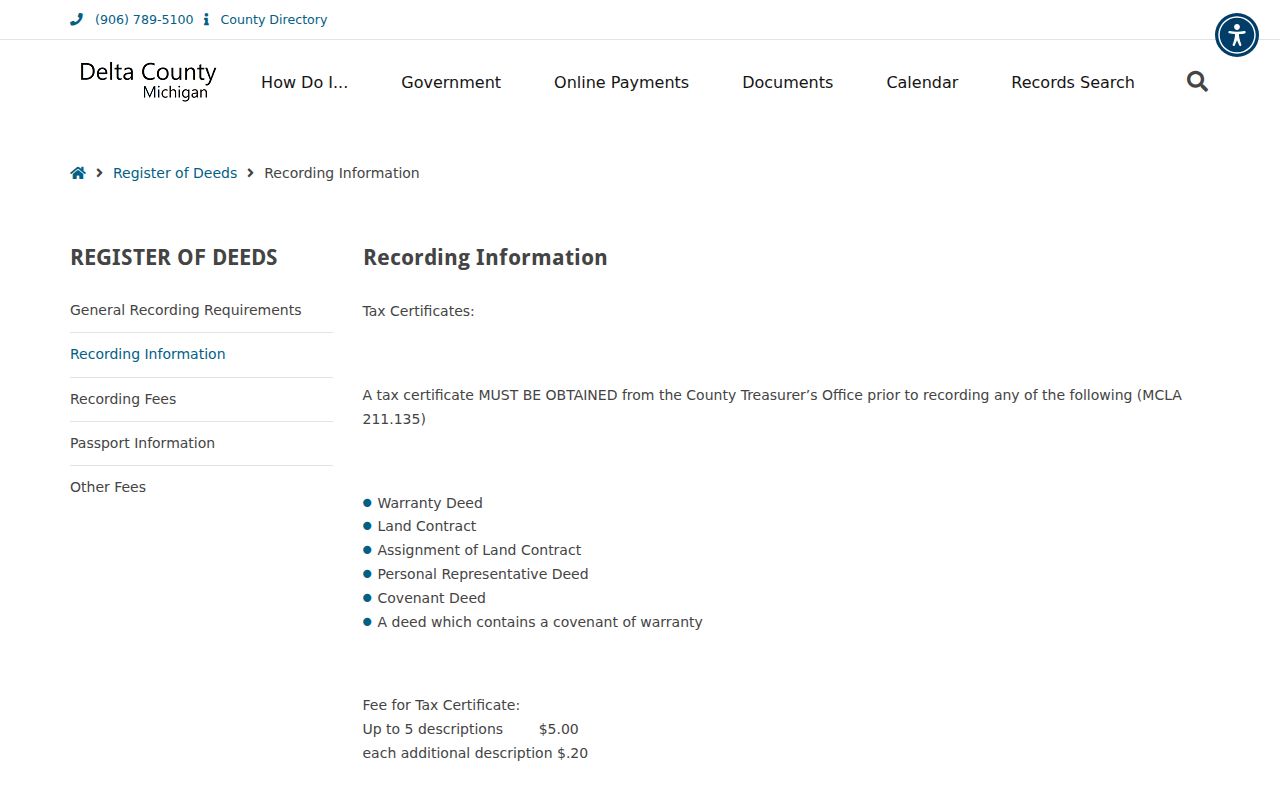
Under MCL 211.135, certification applies to listed warranty and covenant instruments, land contracts and their assignments, and personal representative deeds. The fee schedule shows $5 for up to five legal descriptions. Each extra description adds $0.20. Paying that fee is separate from the Register of Deeds recording charge.
The county's recording-information page shows the tax-certificate prerequisite used for qualifying transfers.
Verify Delta County Tax Demands
Michigan Treasury warns of impostors using out-of-state numbers to seek payment or bank details. Treat any unsolicited demand as a reason to verify, not as proof of debt. Open the official county or BS&A route on your own. Then call a number Delta County itself publishes. Do not rely on the number in the demand.
Check the source. Never send tax payment or banking details through a link or phone number supplied only by an unexpected message.
Ask the Treasurer for the tax year, parcel, current payoff, deadline, and accepted payment method. A quote that was legitimate can still go stale once interest, fees, or a payment posts. Keep the time and the staff source for any phone figure.
Get Delta County Tax Help Offline
Start with the city or township assessor for assessment facts, exemption status, and Board of Review questions. The local collector handles current bills before turnover. For delinquent collection, call the County Treasurer at (906) 789-5100 or (906) 789-5171 during 8:00 a.m. to 4:00 p.m. office hours. During handoff, the tax page lists (906) 789-5117 for payment-status calls.
When an assessment, building, permit, or correspondence file is not online, file a focused request through the Delta County FOIA page. State law allows five business days for a response, plus one written extension of up to ten more. Name the parcel, address, date range, and record type. Fees may cover permitted search, review, copying, and mailing costs.
FOIA cannot force a new tax calculation or a legal opinion. A court foreclosure file belongs with the court clerk. Recorded liens and deeds stay with the Register of Deeds.