
The Values on a Delta County Property Record
Delta County property records carry distinct figures with distinct jobs. State equalized value equals half of true cash value. Taxable value follows the capped-value system, a recorded deed supplies a sale clue, and land and improvement components describe the assessor's model.
| Value | What It Is | Where |
|---|---|---|
| Assessed value | One-half of true cash value after equalization | BS\&A assessment record |
| Market / appraised value | True cash or market-value basis behind SEV | BS\&A assessment record |
| Last sale price | Recorded transfer or assessor sale-history clue | Deed and parcel sale history |
| Land vs improvement | Mass-appraisal components, not separate sale prices | BS\&A assessment record |
Assessed value is not a sale price. Michigan sets SEV at 50 percent of true cash value. Taxable value can sit below SEV because Proposal A caps yearly growth until a qualifying transfer uncaps it.
Michigan's 50 Percent Rule Shapes Delta County Assessed Value
Michigan law fixes assessed value and state equalized value at 50 percent of true cash value. True cash value is the usual selling-price standard. The assessor reaches it through mass appraisal, though. It is not a negotiated sale of the parcel itself. Any Delta County property record should therefore be read with its year, classification, land component, improvement component, and local unit in view.
Equalization keeps assessments at that statutory level across local units. That guarantee stops short of sale prices. Condition, timing, unusual improvements, shoreline facts, easements, and buyer behavior all matter. Each can push a real transaction to a different result. Similar parcels can still diverge.
Value is not price. Assessed value is used in tax administration. It is not a licensed appraisal or a promise of what Delta County property would sell for.
Capped Value Explains Delta County Taxable Differences
Taxable value follows Michigan's Proposal A framework. Capped value starts from the prior taxable value. Inflation, losses, and additions adjust it each year. Taxable value is generally the lower of SEV and capped value, which explains why two similar parcels can carry nearly identical assessed values yet different taxable figures.
A qualifying transfer can uncap taxable value the following year, subject to statutory rules and exemptions. The building did not suddenly gain that much market value. The tax base simply changed under Michigan law. Keep transfer timing separate from improvements, reclassification, and a fresh valuation-year estimate.
- Assessed value
- The local assessor's 50-percent true-cash-value figure.
- State equalized value
- The assessed value after county and state equalization.
- Capped value
- The statutory limit calculated from the prior taxable base, inflation, losses, and additions.
- Taxable value
- The figure used as the property-tax base, generally the lower of SEV and capped value.
- Reassessment
- The regular process of reviewing property data and value for a new year.
Read Delta County BS&A Value Fields Together
The Delta County BS&A service offers several routes into a value record. Choose Current Tax Search, Delinquent Tax Search, Assessing Search, or Detailed Record Search. Searches by Address, Name, and Parcel Number are also offered. Start with the exact local unit and parcel number. The local assessing district maintains the record.
The official BS&A guide lists what a property card can hold. A card may include address, parcel and account numbers, owner and taxpayer information, tax-year details, land data, legal description, sale history, and building information. Confirm the live Delta labels before quoting a figure. A blank field may simply mean one thing. The district does not supply that data point through the service.
The official portal home displays the Delta County search routes available.
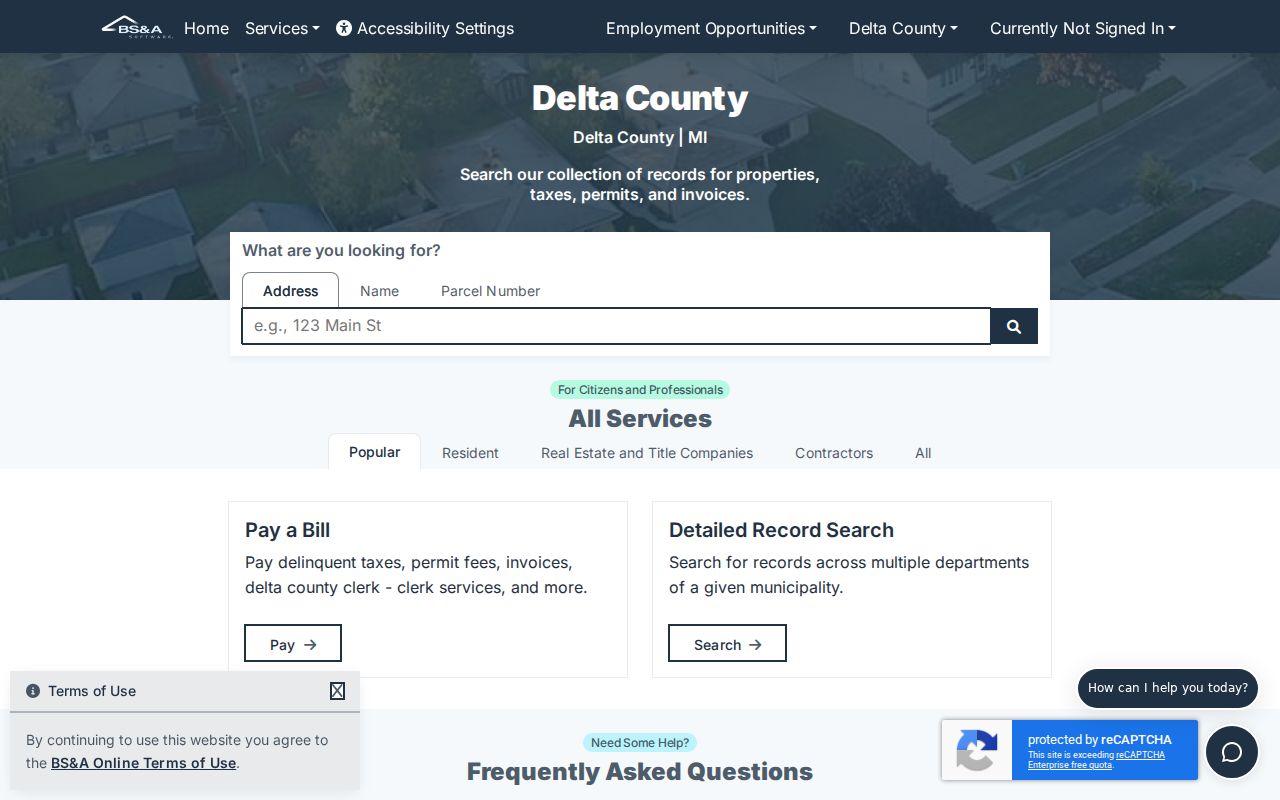
The address, name, and parcel searches all locate the card. Once the record opens, the value labels and tax year control any comparison. The card matters less than its labels.
Note: Compare parcels within the same tax year and property class, or an apparent gap may reflect timing rather than relative value.
Recorded Sales Add Context to Delta County Property Value
A deed may state consideration or leave transfer-tax clues. The assessor record may add sale history where the local data set supplies it. Delta County's published transfer-tax rates are $0.55 per $500 or fraction for the county tax and $3.75 per $500 or fraction for the state tax when the transferred value is at least $100. Exemptions apply.
Those tax amounts are clues, not a sale-price formula. Exempt transfers, family conveyances, quitclaim deeds, estate transactions, multi-parcel instruments, and non-arm's-length deals can all distort a simple comparison. Read the whole picture. Weigh the deed, the document type, the stated consideration, the legal description, and the parcel's sale history together.
Looking Up a Delta County Property Value
Use the Delta County BS&A service to find the parcel. Search by address or APN, then read the tax year and every label before comparing figures across years or properties.
- Search the address or APN in BS\&A Online uid 814]
- Read SEV, taxable value, land, improvements, and tax year
- Check sale history and the recorded deed for transfer context
- Compare like property classes and the same valuation year
- Assessed value
- One-half of true cash value after local assessment and equalization.
- Market / appraised value
- The probable sale-price standard used for true cash value.
- Level of assessment
- Michigan uses 50 percent of true cash value for SEV.
Delta County Exemptions Separate Taxable and Market Meaning
A principal residence exemption changes tax treatment. It does not change what the physical property would bring on the open market. The assessor record may show exemption or PRE status next to the assessed and taxable figures. Never subtract an exemption from market value, and never borrow one owner's tax result as an estimate for another owner.
The details of tax bills, exemptions, and appeals live on the Delta County property tax records page. For value work, the point is narrower. Identify which number is being reduced or capped. And never relabel taxable value as full market value.
Escanaba and Gladstone Need Parcel-Level Comparisons
Escanaba's assessment FAQ walks through Tax Day. It also covers SEV at half of market value, capped value, taxable value, and the March appeal window. Gladstone's materials bring in zoning district, lot dimensions, building area, and floodplain notes. Together they explain why two similar parcels carry different assessments. Neither one proves a trend across a whole neighborhood.
No official district-level ranking exists for Escanaba's historic grid versus its annexation areas. The same is true for Gladstone's shoreline, bluff, older additions, and newer subdivisions. A fair comparison needs current BS&A cards, matching years and classes, and recorded sale histories. Land, improvements, zoning, and flood context all matter too.
Archives Preserve Older Delta County Value Evidence
The Archives of Michigan finding aid covers Delta County assessment rolls from 1881 through 1900 and Sac Bay Township rolls from 1885 through 1904. A Library of Michigan guide adds a 1913 atlas, a 1943 plat book, and a 1962 plat book with an owner index. Old rolls and plats answer questions of their own era. They are not present-day market estimates.
Use each source in its period. Cite the year and local unit. Then pair the entry with deeds and plats before drawing conclusions. Never convert a historic assessed figure into a modern Delta County property value without a clear method and solid market evidence.
What a Delta County Assessor Value Is Not
A Delta County assessment is a mass-appraisal figure built for tax administration. It is not a property-specific appraisal, and it may not match what buyers and sellers decide today.
Value vs price. [1-2 sentences - a Delta County assessor value is not what a property will sell for; for a sale or loan, get a licensed appraisal.]